
How to invest an inheritance: key things to consider
Discover how to invest an inheritance, from building a diversified, long‑term investment strategy to using tax‑efficient options.

An inheritance can bring mixed emotions. Alongside the loss of a loved one, you may find yourself suddenly responsible for a large sum of money – and unsure what to do next.
The good news is that you don’t need to have all the answers right away. An inheritance can make a meaningful difference to your future, and with a clear, long‑term plan, investing it thoughtfully can help you make the most of what you’ve been given.
1. Take stock of your finances
A good place to start is to take stock of your overall finances, so you know where you are with things.
Some of the questions to consider include:
- Do you have an emergency fund set aside? This is important for things like replacing a broken boiler or a spell of unemployment.
- Are you in debt? It’s worth checking whether you have any high-interest debts, like personal loans, as clearing them early can reduce the amount of interest you’ll have to pay.
- Do you have any immediate financial priorities? It’s useful to know if you need to pay for something soon, such as a new bathroom, so you can set that money aside.
2. Make your inheritance work harder over time
When you receive a large sum of money, it’s natural to put it somewhere familiar – like a bank account – while you decide what to do next. And you might feel you’re keeping it safe, particularly if you’re worried about making a mistake with it.
But savings accounts aren’t risk free. Inflation erodes the value of money over time, meaning you’ll be able to buy less with it in the future. Savings accounts don’t typically offer enough growth to offset that, especially after any tax is paid.
That’s where investing comes in. Historically, shares have delivered higher returns than cash over time.
Let’s imagine you put £10,000 in a bank account and invested the same amount in global shares at the end of December 2004. Your investment would have earned you almost £70,000 more than your cash by the end of 2025.
Here’s how it happens:
- The £10,000 in your bank account would have grown to around £15,600. After inflation1, it would only be worth around £4,100.
- Your £10,000 investment in global shares would have grown to around £86,400. This would be worth around £74,000 after inflation.
Returns from £10,000 in cash and shares, before and after the effects of inflation
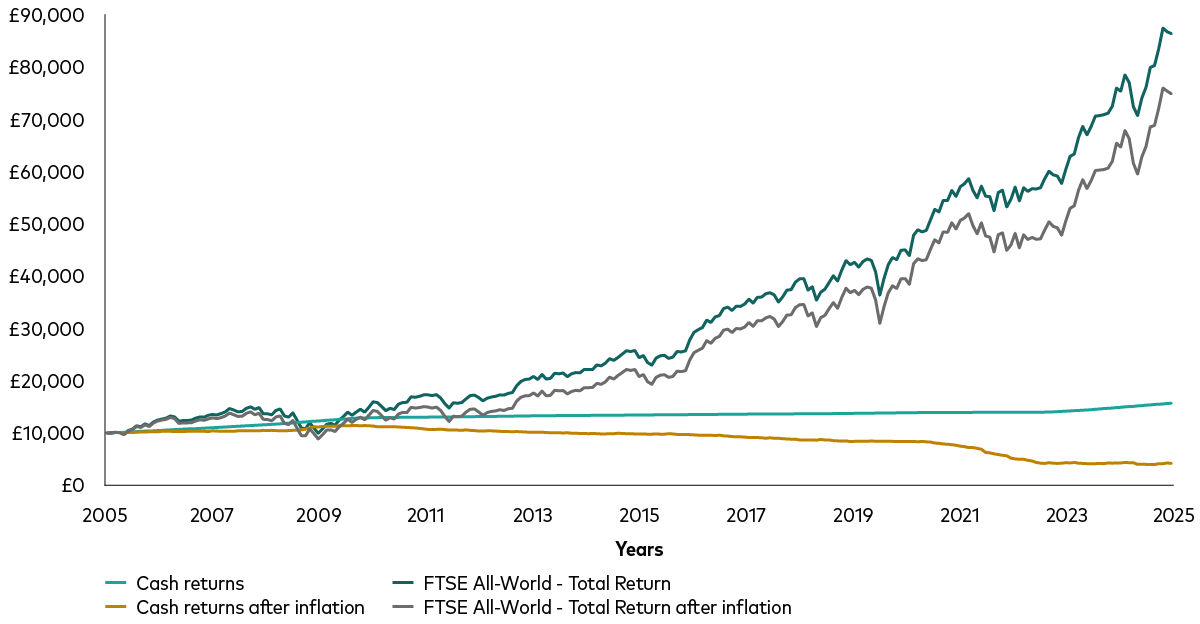
Past performance is not a reliable indicator of future results. The performance of an index is not an exact representation of any particular investment, as you cannot invest directly in an index.
Notes: Cash returns represented by the UK Sterling Overnight Index Average benchmark (SONIA), which reflects the average rate of interest banks pay to borrow overnight. Global shares represented by the FTSE All-World Index with dividends reinvested. Inflation represented by the UK Retail Price Index (RPI).
Source: Factset, Vanguard calculations based on period 31 December 2004 to 31 December 2025.
If you’re worried about investing at the “wrong” time when markets feel choppy or particularly high, you don’t have to commit all your money at once. You can invest a lump sum gradually by spreading it into regular, fixed payments.
This is known as pound-cost averaging and it helps smooth out market ups and downs.
3. Think about what you want your money to do
Being clear about what you want to use your inheritance for helps you choose the right investments and level of risk for you.
The level of risk is important because any money you expect to need in the next few years shouldn’t be exposed to market swings as it might not have time to recover. On the other hand, taking risk is important for money you’ll need in the future – like saving for retirement or your children’s university costs – as it’ll give it a chance to grow and beat inflation.
If you haven’t thought about your goals for a while, it’s worth reviewing them to make sure they still reflect your circumstances and priorities today.
4. Build a balanced investment strategy that fits your goals
Now that you know when you’ll need your money, and what it’s for, you can build an investment strategy to achieve your goals in a way that feels right for you.
A balanced portfolio is key. We believe it could have a bigger impact on your returns than anything else you do. Balance refers to the percentage of shares and bonds2 you have. Shares help your money grow over time, but they come with more ups and downs along the way. Bonds tend to move around less, but offer lower growth potential.
The other vital ingredient to investment success is making sure you invest across different countries and sectors. This helps soften the impact if one area underperforms and allows you to benefit when others are doing well.
Building a balanced portfolio might seem complicated, but it doesn’t have to be. At Vanguard, we offer a range of services to help you get started.
You can build your own portfolio from our wide range of low-cost individual funds. Or you can keep things simple by picking one of our LifeStrategy funds or Target Retirement funds, which combine shares and bonds in one ready-made portfolio. If you want more of a helping hand, we offer a managed service where we ask you a few questions about how you feel about risk and, based on those answers, select a portfolio of investments for you.
5. Use tax‑efficient accounts to keep more of what your money earns
Once you have a plan in place, tax‑efficient accounts can help you keep more of what your inheritance earns over time.
For example, you can invest up to £20,000 each tax year in a stocks and shares ISA and any returns are tax free.
If you won’t need the money for a while, you could consider paying it into a personal pension and get tax relief from the government. This can significantly boost your retirement savings. For every £80 you pay in, you get £20 in tax relief on top. If you’re a higher-rate (40%) or additional-rate (45%) taxpayer, you can claim extra tax relief through a self-assessment tax return.
Most people can pay up to 100% of their gross (pre-tax) relevant earnings3 into their pension each tax year, up to a maximum of £60,000. However, you may be able to pay in more than this by carrying forward unused annual allowances from the previous three tax years.
If you’ve already used up this tax year’s allowances, you can also invest in a general account, where you can earn up to £3,000 in profits before you have to pay capital gains tax.
6. Think about what you’d like your inheritance to mean for others
You may also want to think about how your inheritance fits into your wider plans for family, friends or causes that matter to you. This can be a good prompt to make a will – or review an existing one – so your wishes are clear.
Handled thoughtfully, an inheritance can become something that supports you and your family, now and in the years ahead.
1 Inflation is the rise in prices for goods and services over time, meaning your money buys less than it used to.
2 Bonds are a type of loan issued by governments or companies, which typically pay a fixed amount of interest and return the capital at the end of the term.
3 For more on what counts as ‘relevant earnings’ that can earn tax relief when used to fund a pension, see the HMRC Pensions Tax Manual.

Investment risk information
The value of investments, and the income from them, may fall or rise and investors may get back less than they invested.
Past performance is not a reliable indicator of future results.
The eligibility to invest in either ISA or Junior ISA depends on individual circumstances and all tax rules may change in future.
Eligibility to invest in a Vanguard Personal Pension depends on your individual circumstances. Please be aware that pension and tax rules may change in the future and the value of investments can go down as well as up, so you might get back less than you invested. You cannot usually access your pension savings or make any withdrawals until the age of 55, rising to the age of 57 in 2028.
If you are not sure of the suitability or appropriateness of any investment, product or service you should consult an authorised financial adviser. Please note this may incur a charge.
Any tax reliefs referred to are those available under current legislation, which may change, and their availability and value will depend on your individual circumstances. If you have questions relating to your specific tax situation, please contact your tax adviser.
The Vanguard LifeStrategy® Funds and Vanguard Target Retirement Funds may invest in Exchange Traded Fund (ETF) shares. ETF shares can be bought or sold only through a broker. Investing in ETFs entails stockbroker commission and a bid-offer spread which should be considered fully before investing.
For further information on risks please see the “Risk Factors” section of the prospectus on our website.
Important information
Vanguard only gives information on products and services and does not give investment advice based on individual circumstances. If you have any questions related to your investment decision or the suitability or appropriateness for you of the product[s] described, please contact your financial adviser.
For further information on the fund's investment policies and risks, please refer to the prospectus of the NURS and to the KII before making any final investment decisions. The KII for this fund is available, alongside the prospectus via Vanguard’s website.
This is designed for use by, and is directed only at, persons resident in the UK.
The information contained herein is not to be regarded as an offer to buy or sell or the solicitation of any offer to buy or sell securities in any jurisdiction where such an offer or solicitation is against the law, or to anyone to whom it is unlawful to make such an offer or solicitation, or if the person making the offer or solicitation is not qualified to do so. The information is general in nature and does not constitute legal, tax, or investment advice. Potential investors are urged to consult their professional advisers on the implications of making an investment in, holding or disposing of shares and/or units of, and the receipt of distribution from any investment.
Vanguard will manage your investments in the Managed ISA and Managed SIPP on your behalf. You will not be able to place trades on your own account.
The Authorised Corporate Director for Vanguard LifeStrategy Funds ICVC is Vanguard Investments UK, Limited. Vanguard Asset Management, Limited is a distributor of Vanguard LifeStrategy Funds ICVC.
For investors in UK domiciled funds, see our summary of investor rights and is available in English.
Issued by Vanguard Asset Management Limited, which is authorised and regulated in the UK by the Financial Conduct Authority.
© 2026 Vanguard Asset Management Limited. All rights reserved.
5503437