
Proof you don’t need perfect timing to outperform cash
If you invested right before the major stock market shocks of the past 30 years, you’d still be better off than if you’d left your money in cash.


Staying invested matters far more than trying to predict market movements – and research from Vanguard has proven that.
We looked at a hypothetical ‘unluckiest investor’ – someone who invested lump sums of money at the worst possible moments: just before the dot-com crash, the global financial crisis, the Covid-19 sell-off and other major stock market downturns. Despite such unfortunate timing, they still substantially outperformed cash in the long run.
In fact, those lump sum contributions – £45,000 in total since 1997 – would have grown to just under £200,000 by February 2026, a gain of 340%. Left in cash, the same amount would have risen by only 42% to £63,980.
Read on to find out why successful investing comes from time in the market and not timing the market.
The ‘unluckiest investor’
We looked at what would have happened if an investor put money into the stock market before each major market sell-off since 1997. In this hypothetical scenario, the investments were made into the FTSE All World – an index of global shares.
- September 1997: The first investment of £2,500 was made just before the Asian financial crisis, sending the portfolio down £228 in the first month.
- July 1998: A second £2,500 went in shortly before Russia’s debt default and the collapse of Long-Term Capital Management, leaving the investor down £844 a month later.
- January 2000: A £10,000 investment was made at the height of the dot-com bubble – a period when technology stocks shot up rapidly. The bubble began to burst in March that year. The 9/11 attacks in 2001 and ensuing war in Afghanistan pushed the portfolio down by nearly 32% (a loss of almost £5,000) by September 2002. But recovery followed, and by 2007 the total £15,000 of contributions was back in the green at £21,153.
- October 2007: A further £5,000 was invested just before the global financial crisis started. Despite the sharp downturn, the rebound that followed meant that by the end of 2019, the total investment of £20,000 was worth over £75,000 – a rise of 277% in just over 22 years.
- December 2019: Another £10,000 was added. Just two months later, concerns around Covid-19 triggered a rapid global market crash, pushing the portfolio down to £71,776 – a 16% drop from the start of January to the end of March 2020.
- December 2021: After markets rebounded strongly, another £5,000 was invested – just before the Russia-Ukraine conflict, rising inflation1 and rapid interest rate hikes.
- December 2024: A final £10,000 investment brought total contributions to £45,000. Shortly afterwards, US trade tariffs shook markets – causing the portfolio to fall by 9.5% in just four days – although they made a full recovery later that year.
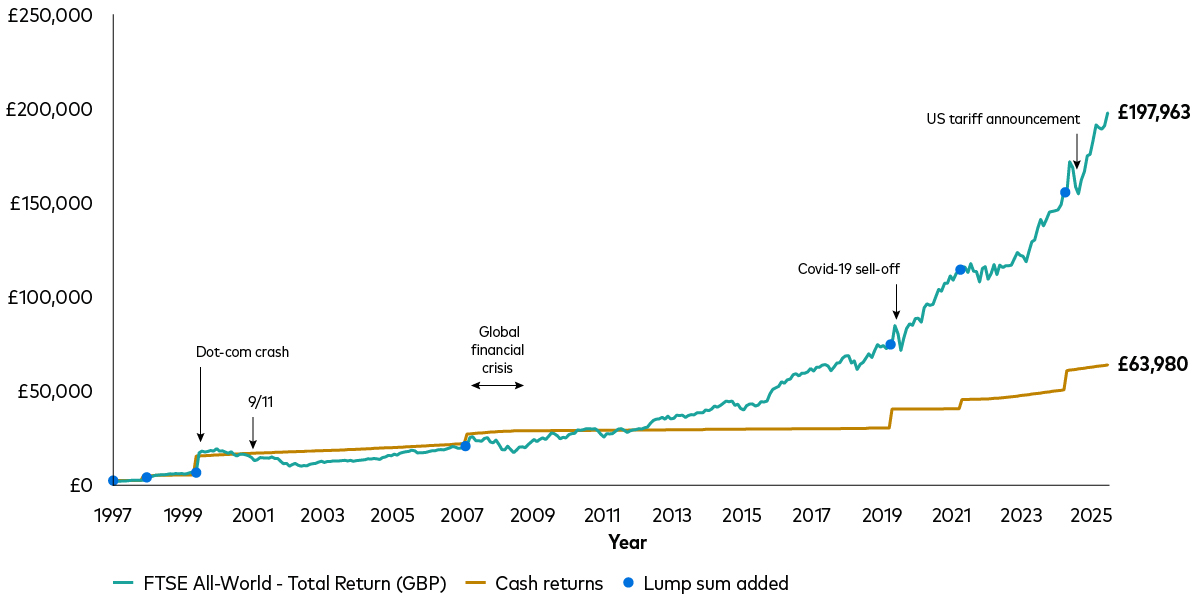
By the end of February 2026, the investor wasn’t so unlucky after all. As the chart below shows, their £45,000 contributions became £197,963.
If they’d held the same money in cash savings, it would have reached only £63,980 – around £134,000 less.
Investing at the worst possible times: how it compares with cash
Past performance is not a reliable indicator of future results. The performance of an index is not an exact representation of any particular investment, as you cannot invest directly in an index.
Notes: The chart compares cash returns (based on Bank of England interest rates2) with the FTSE All-World Total Return Index from 30 September 1997 to 27 February 2026. The investor makes seven lump sum contributions totalling £45,000.
Source: Vanguard calculations in GBP, based on data from Factset and Bloomberg, as at 8 March 2026.
It’s important to note that despite the investor’s gains, our hypothetical scenario was a particularly ‘bad’ one, with investments made at the worst possible times. Most investors will likely have materially higher returns over the same period.
Our research shows that had the whole £45,000 investment been made at the outset in September 1997, it would have risen by a staggering 977% to £439,822.
Why staying invested beats market timing
So how can someone who invested right before every market downturn still see their money grow? It’s because successful investing isn’t about predicting what markets will do next – it’s about discipline, focusing on the long term and resisting the urge to react to short-term shocks.
Despite facing one market shock after another, our hypothetical investor stayed invested. If they had panicked and sold out when the market dropped, they would have locked in losses and missed out on the subsequent rebounds.
While markets inevitably rise and fall, shares have historically delivered much stronger returns than cash over long periods. Although downturns can feel unsettling, it’s important to remember that markets usually recover and continue to grow over time.
Staying invested also enables you to harness the full power of compounding – when you earn returns on the money you invest as well as on the returns themselves. Over time, compounding can turn even modest contributions into a much larger sum.
1 Inflation is the rise in prices for goods and services over time, meaning your money buys less than it used to.
2 The Bank of England’s interest rate for January to February 2026 was unavailable so the rate for previous month has been used.

Investment risk information
The value of investments, and the income from them, may fall or rise and investors may get back less than they invested.
Past performance is not a reliable indicator of future results.
Important information
Vanguard only gives information on products and services and does not give investment advice based on individual circumstances. If you have any questions related to your investment decision or the suitability or appropriateness for you of the products described, please contact your financial adviser.
This is designed for use by, and is directed only at, persons resident in the UK.
The information contained herein is not to be regarded as an offer to buy or sell or the solicitation of any offer to buy or sell securities in any jurisdiction where such an offer or solicitation is against the law, or to anyone to whom it is unlawful to make such an offer or solicitation, or if the person making the offer or solicitation is not qualified to do so. The information does not constitute legal, tax, or investment advice. You must not, therefore, rely on it when making any investment decisions.
Issued by Vanguard Asset Management Limited, which is authorised and regulated in the UK by the Financial Conduct Authority.
© 2026 Vanguard Asset Management Limited. All rights reserved.
5314881