
How often should I check my portfolio?
Checking your portfolio is fine. Acting on short-term market movements usually isn’t. We explore how often to review your investments and what to consider when you do.

It’s natural to want to check how your investments are performing and whether you’re on track to achieve your goals. In instances where markets are volatile you may want to do this more regularly – perhaps weekly or even daily.
The truth is that there is no “right” frequency. You can check your investments as often as you like. What matters far more is how you respond to what you see.
When might you check your investment portfolio?
Some investors like to look regularly, while others prefer to check in occasionally. Some even “set and forget” where after making an investment, they will only see how their performance is doing when they receive an update or annual review, for example.
None of these approaches are wrong. Reviewing your portfolio can help you stay engaged and feel confident that your investments are still aligned with your goals and attitude to risk. But checking too often can also have a negative impact.
How often is too often?
Periods of market volatility can make investors want to check more often – and that’s completely normal. When prices move sharply or the news feels unsettling, many people naturally look for reassurance.
The challenge comes when short‑term market movements trigger the urge to act. Those knee-jerk, emotional decisions are understandable, but they rarely lead to positive long-term outcomes. That’s why it’s important to step back, focus on the long term and keep sight of the bigger picture.
The image below illustrates why perspective matters. It shows what looks like a significant drop in the FTSE All-World early last year following the US tariff announcements. However, when you zoom out beyond that period and look at the index over the past 10 years, you can see that it has grown significantly and that any market falls look minor in comparison.
Remembering the “bigger picture”
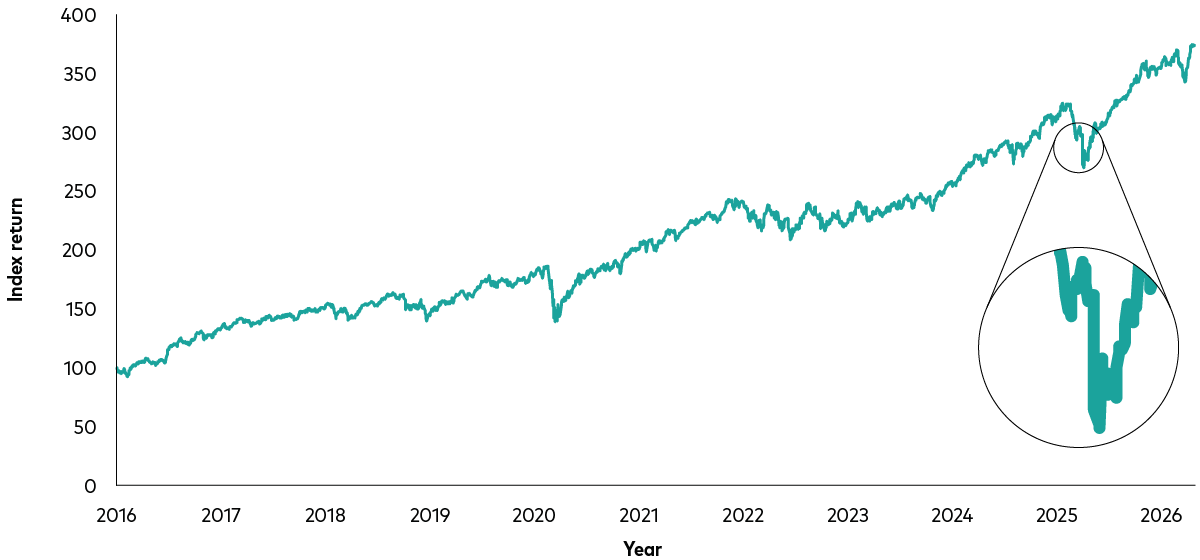
Source: Bloomberg, as at 4 May 2026. Notes: The chart shows total returns from 1 January 2016 until 30 April 2026 for the FTSE All-Share World index in GBP. The index was rebased so that 1 January 2016 equals 100. The ‘magnified’ section shows the period between 27 March 2025 and 7 May 2025.
Checking too often, especially during volatile periods, can make these short‑term movements feel larger and more meaningful than they really are. Frequent checking can increase anxiety and heighten the temptation to react to short‑term noise – such as selling after markets fall.
It's easy to think what has happened will keep happening – this is called recency bias – but focusing too much on recent market movements can cause you to overreact and ignore the bigger picture. As the chart above shows, the market drop last year was soon followed by a rally. This happened again earlier this year when war broke out in the Middle East.
If you sell during a downturn, you’re likely to buy back in when you feel more confident. But by that time, the market may have already recovered, causing you to lock in losses and miss out on potential gains. This cycle can increase uncertainty the next time markets become volatile. This kind of behaviour can undermine long‑term outcomes; it’s usually better to stick with a steady, long-term investment plan and weather any short-term fluctuations.
Why it helps to separate checking from doing
A useful way to manage this is to separate checking from doing. Checking your portfolio can help you understand what’s happening. Taking action is different and usually only makes sense when something meaningful has changed – such as your goals or personal circumstances (more on that below).
Checking portfolios too often can also lead to what behavioural scientists call “reference dependence” – where someone looks at their performance relative to a reference point, rather than in absolute terms. For example, if they invest right before a market rise, they may come to expect that level of performance to continue.
But because markets move every day, frequent checking increases the chances of seeing temporary dips, especially during volatile periods. That can make normal ups and downs feel like losses, prompting unnecessary action that may not be in an investor’s long‑term interests.
When action may be needed
Most long‑term investors don’t need to make changes simply because markets have moved. Action is usually more appropriate when it’s driven by your personal situation or long‑term plan.
For example, you may want to review your portfolio if your goals, time horizon or financial circumstances have changed. Perhaps you are approaching retirement or plan to make a big purchase.
Some investors who build their own portfolios may need to rebalance from time to time to keep their investments aligned with their original strategy. This is when you adjust the proportions of different assets (such as shares and bonds1) in your investment portfolio to maintain the mix that’s right for you.
However, if you invest in ready-made portfolios like our LifeStrategy or Target Retirement funds or use our Managed service, we handle the rebalancing for you.
Bottom line: focus on the long term
Checking your portfolio is fine and important to do from time to time. Acting on short‑term market movements usually isn’t.
Rather than focusing on how often you look at your investments, it can be more helpful to ask whether anything meaningful has changed. If it hasn’t, staying focused on your long‑term goals – and staying the course through market ups and downs – is often the wisest approach.
1 Bonds are a type of loan issued by governments or companies, which typically pay a fixed amount of interest and return the capital at the end of the term.

Investment risk information
The value of investments, and the income from them, may fall or rise and investors may get back less than they invested.
Past performance is not a reliable indicator of future results.
If you are not sure of the suitability or appropriateness of any investment, product or service you should consult an authorised financial adviser. Please note this may incur a charge.
The Vanguard LifeStrategy® Funds and Vanguard Target Retirement Funds may invest in Exchange Traded Fund (ETF) shares. ETF shares can be bought or sold only through a broker. Investing in ETFs entails stockbroker commission and a bid- offer spread which should be considered fully before investing.
For further information on risks please see the “Risk Factors” section of the prospectus on our website.
Important information
Vanguard only gives information on products and services and does not give investment advice based on individual circumstances. If you have any questions related to your investment decision or the suitability or appropriateness for you of the product[s] described, please contact your financial adviser.
For further information on the fund's investment policies and risks, please refer to the prospectus of the NURS and to the KII before making any final investment decisions. The KII for this fund is available, alongside the prospectus via Vanguard’s website.
This is designed for use by, and is directed only at, persons resident in the UK.
The information contained herein is not to be regarded as an offer to buy or sell or the solicitation of any offer to buy or sell securities in any jurisdiction where such an offer or solicitation is against the law, or to anyone to whom it is unlawful to make such an offer or solicitation, or if the person making the offer or solicitation is not qualified to do so. The information is general in nature and does not constitute legal, tax, or investment advice. Potential investors are urged to consult their professional advisers on the implications of making an investment in, holding or disposing of shares and /or units of, and the receipt of distribution from any investment.
Vanguard will manage your investments in the Managed ISA and Managed SIPP on your behalf. You will not be able to place trades on your own account.
The Authorised Corporate Director for Vanguard LifeStrategy Funds ICVC is Vanguard Investments UK, Limited. Vanguard Asset Management, Limited is a distributor of Vanguard LifeStrategy Funds ICVC.
For investors in UK domiciled funds, see our summary of investor rights and is available in English.
Issued by Vanguard Asset Management Limited, which is authorised and regulated in the UK by the Financial Conduct Authority.
© 2026 Vanguard Asset Management Limited. All rights reserved.
5420028