
Are fees eating into your returns?
You can’t control markets, but you can control costs. We explore how small differences in fees can have a big impact on your returns.

In the world of investing, costs are a crucial yet often overlooked factor that can significantly impact long-term financial success. But unlike markets and investment returns, we can control our costs and investors should try to minimise them where possible.
Clarity matters
But to control your costs, you must first be able to understand them. Many investors aren’t aware of all the layers of cost they’re paying, from platform charges to fund expenses to transaction costs. When fees are unclear or unpredictable, it becomes harder to understand your true return or compare one provider with another.
Transparent fees make the whole experience feel more straightforward. Investors know what they’re paying, what to expect over time, and can make more confident decisions as a result.
Some of the fees to look out for are:
- platform or account fees
- trading charges
- fund costs
- additional fees (for example, for clients going into drawdown)
The quiet impact of costs
Small charges can add up and take a slice of your return every year.
Investing charges might not sound like big numbers, but if you're getting a return of 5% and paying 2% in charges, that's almost half of your returns gone. In the graph below, we show what £50,000 could look like over 30 years, with four different fee scenarios and assuming a return of 5.5%.
A £50,000 portfolio with a fee of 1.5% would be worth £158,000 after 30 years. But the same pot with a fee of 0.5% would be worth over £214,000. For a seemingly small difference in fees of just 1%, that’s a significant difference of more than £55,000. Meanwhile, the same pot with a 2% fee would be around £78,000 worse off.
How costs can impact portfolio growth
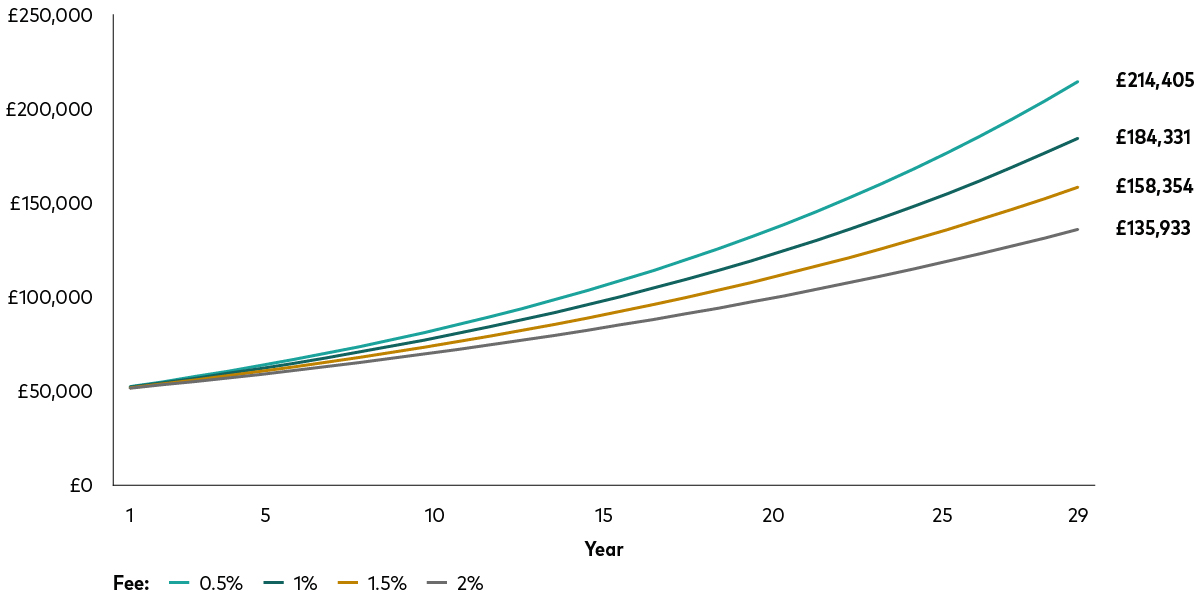
Source: Vanguard calculations. The portfolio balances shown are hypothetical and do not reflect any particular investment.
The chart illustrates that in an instance where the only difference between funds are their fees (so the same fund with the same performance over the same time horizon), then generally speaking, the lower the fee, the higher the return because more money stays invested.
High fees are simply a hurdle that a fund manager needs to overcome to break even. A high fee is like starting a race behind the start line.
A low‑cost mindset
At Vanguard, we focus on low, transparent costs. That means simple pricing, no hidden extras and a continual effort to reduce underlying fund costs over time. We will always list the fees you have to pay, a breakdown of which you can see on our fees and charges page.
What’s more, when savings are made, they’re passed back to our investors – helping more of your return stay exactly where it belongs. In 2025, we reduced the fees on seven of our bond ETFs and six of our equity ETFs and earlier this year we did the same for our LifeStrategy fund range. These reductions meant more than £26 million was given back to investors.
A small choice with a big payoff
Fees might not be the most exciting part of investing, but they’re one of the few things you can control. Keeping them low is a simple step that can make a real difference to your financial future. Over time, that small ongoing decision helps ensure more of your returns go towards building your wealth – and not paying unnecessary costs.
Investment risk information
The value of investments, and the income from them, may fall or rise and investors may get back less than they invested.
Any projections should be regarded as hypothetical in nature and do not reflect or guarantee future results.
Vanguard LifeStrategy®Funds may invest in Exchange Traded Fund (ETF) shares. ETF shares can be bought or sold only through a broker. Investing in ETFs entails stockbroker commission and a bid- offer spread which should be considered fully before investing.
For further information on risks please see the “Risk Factors” section of the prospectus on our website.
Important information
Vanguard only gives information on products and services and does not give investment advice based on individual circumstances. If you have any questions related to your investment decision or the suitability or appropriateness for you of the products described, please contact your financial adviser.
For further information on the fund's investment policies and risks, please refer to the prospectus of the UCITS/ NURS and to the KIID/KII before making any final investment decisions. The KIID/KII for this fund is available, alongside the prospectus via Vanguard’s website.
This is designed for use by, and is directed only at, persons resident in the UK.
The information contained herein is not to be regarded as an offer to buy or sell or the solicitation of any offer to buy or sell securities in any jurisdiction where such an offer or solicitation is against the law, or to anyone to whom it is unlawful to make such an offer or solicitation, or if the person making the offer or solicitation is not qualified to do so. The information does not constitute legal, tax, or investment advice. You must not, therefore, rely on it when making any investment decisions.
The Authorised Corporate Director for Vanguard LifeStrategy® Funds ICVC is Vanguard Investments UK, Limited. Vanguard Asset Management, Limited is a distributor of Vanguard LifeStrategy Funds ICVC.
Issued by Vanguard Asset Management Limited, which is authorised and regulated in the UK by the Financial Conduct Authority.
© 2026 Vanguard Asset Management Limited. All rights reserved.
5289963