
Six common investing mistakes to avoid
We look at six common investment mistakes to avoid, from not setting clear goals to reacting to short-term market moves.

Jack Bogle, who founded Vanguard more than 50 years ago, believed that successful investing involves doing a few things right and avoiding serious mistakes. And his message remains just as relevant today.
The good news is that many of the biggest investing mistakes are easy to avoid.
To help set you up for investment success, we look at six of the most common mistakes that could affect your long-term returns.
1. Not having clear goals
Clear goals can help you choose investments that are right for you.
For example, someone who wants to retire next year is likely to need different investments from someone who has 30 years until retirement.
Generally, the closer you are to needing your money, the less risk you should take. This is because your investments have less time to recover from market falls. One way to lower risk is to hold more bonds1 than shares in your portfolio. Bonds have historically offered lower, but more stable, returns than shares.
If your goal is many years away, you have more time to ride out the market's ups and downs. Taking more risk by holding more shares than bonds gives your investments greater potential for long-term growth. Shares have historically offered higher returns than bonds over the long term.
2. Putting too much money in one place
We all know the saying “don’t put all your eggs in one basket”. The same idea applies to investing.
If too much of your money is in one company, sector or region, your portfolio could be hit harder if that area performs badly.
Spreading your investments across different companies, sectors and regions can reduce the impact if one area of the market struggles and allows you to benefit from growth wherever it comes from.
After all, no one can predict with certainty which parts of the market will perform best in the future.
3. Paying more in costs than you need to
Investment costs may seem small, but they can add up. The more you pay in charges, the less of your returns you get to keep.
Imagine you had a £50,000 portfolio with a fee of 1.5% and a 5.5% return. After 30 years it would be worth £158,000. But if your fee was only 0.5%, it would be worth over £214,000.
That’s a difference of more than £55,000.
And if the same pot had a 2% fee, you’d be around £78,000 worse off.
How costs can impact portfolio growth
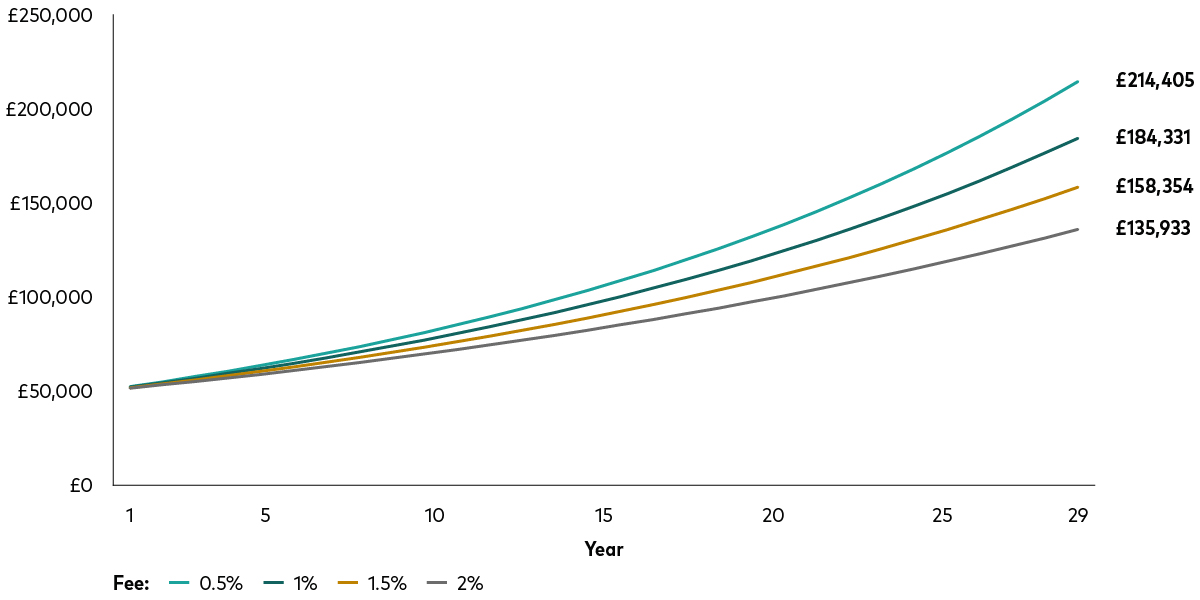
Source: Vanguard calculations. Assumes a return of 5.5% a year before fees. The portfolio balances shown are hypothetical and do not reflect any particular investment.
Check your investment charges and make sure you’re not paying more than you need to.
4. Reacting emotionally to short-term market moves
It can feel unsettling when markets are volatile.
But reacting emotionally to short-term market moves can lead to decisions you may later regret. For example, selling after markets have fallen could mean locking in losses and missing out when markets recover.
It can also be difficult to know when to invest again. If you wait too long, you could miss some of the strongest days in the market, which can make a big difference to your long-term returns.
So stay disciplined, focus on your long-term goals and look beyond short-term volatility.
5. Chasing recent winners
It can be tempting to choose investments that have done well recently.
But recent performance doesn’t guarantee what will happen next. By the time something has become a “winner”, its price may already have risen significantly. Buying at that point could mean you’re investing just before returns slow down or fall.
That’s why it’s sensible to have a diversified portfolio based on your goals and how much risk you’re comfortable taking.
A steady, long-term plan can help you avoid chasing trends and have the discipline to stay focused on what’s right for you.
6. Not using tax allowances
Tax is easy to overlook, especially if you’re new to investing or aren’t familiar with the different incentives available.
But over time, paying more tax than necessary could reduce the amount you keep from your investments. That's why it's worth making the most of tax-efficient accounts.
Investing through an individual savings account (ISA) or a pension ensures more of your money stays invested and working towards your goals.
Any growth, dividends2 and interest generated by investments in a stocks and shares ISA are tax free, while personal pension contributions benefit from tax relief.
Understanding the allowances available and how they fit with your goals can help you make the most of your long-term savings.
1 Bonds are a type of loan issued by governments or companies, which typically pay a fixed amount of interest and return the capital at the end of the term.
2 Dividends are the payments some companies make to their shareholders out of their profits.

Investment risk information
Investing gives your money the opportunity to grow over time, but market movements mean values can rise and fall along the way.
Any projections should be regarded as hypothetical in nature and do not reflect or guarantee future results.
Eligibility to invest in a Vanguard Personal Pension depends on your individual circumstances. Please be aware that pension and tax rules may change in the future and the value of investments can go down as well as up, so you might get back less than you invested. You cannot usually access your pension savings or make any withdrawals until the age of 55, rising to the age of 57 in 2028.
If you are not sure of the suitability or appropriateness of any investment, product or service you should consult an authorised financial adviser. Please note this may incur a charge.
The eligibility to invest in either ISA or Junior ISA depends on individual circumstances and all tax rules may change in future.
Any tax reliefs referred to are those available under current legislation, which may change, and their availability and value will depend on your individual circumstances. If you have questions relating to your specific tax situation, please contact your tax adviser.
Important information
This is a marketing communication.
Vanguard only gives information on products and services and does not give investment advice based on individual circumstances. If you have any questions related to your investment decision or the suitability or appropriateness for you of the product(s) described, please contact your financial adviser.
This is designed for use by, and is directed only at, persons resident in the UK.
The information contained herein is not to be regarded as an offer to buy or sell or the solicitation of any offer to buy or sell securities in any jurisdiction where such an offer or solicitation is against the law, or to anyone to whom it is unlawful to make such an offer or solicitation, or if the person making the offer or solicitation is not qualified to do so. The information does not constitute legal, tax, or investment advice. You must not, therefore, rely on it when making any investment decisions.
Issued by Vanguard Asset Management Limited, which is authorised and regulated in the UK by the Financial Conduct Authority.
© 2026 Vanguard Asset Management Limited. All rights reserved.
5943202