
Booms and busts: how to keep your head as an investor
Learn why booms and busts happen and how to navigate the highs and lows, from staying invested to focusing on your long-term goals.

We’ve had ‘tulip mania’ and the dot-com bust. And now we’re in the middle of an artificial intelligence (AI) boom.
While every boom and bust has its own story, they often follow a surprisingly familiar pattern. Understanding how these economic cycles work can help you avoid making emotional decisions when markets are at their most exciting – and most nerve-wracking.
The past is littered with booms and busts
History is full of periods when prices rose rapidly before falling just as quickly. A new idea captures the imagination, prices rise, optimism grows and investors rush in. Eventually, expectations run ahead of reality and prices fall back down.
Some of the most famous examples include ‘tulip mania’ in 17th-century Holland, when prices for rare tulip bulbs soared before collapsing dramatically.
Many investors will remember the dot-com bubble (1990s–2000) when investors poured money into internet and technology companies, despite many generating little or no profit. When enthusiasm eventually gave way to reality, share prices tumbled and many businesses failed.
Today, AI is driving excitement in markets, with investors closely watching how the technology develops and how widely it is adopted.
Why booms happen
Most booms start with a genuinely positive development. It could be a breakthrough technology, a new industry, lower interest rates or another event that creates excitement about future growth.
As optimism grows, demand increases and share prices start rising. Investors may believe the new opportunity will generate higher profits or stronger economic growth.
Rising share prices often attract more investors. People see others making money and don't want to miss out. This is known as herd behaviour.
The more share prices rise, the stronger the belief becomes that they'll keep rising. Eventually, some investors start thinking that the old rules no longer apply and that ‘this time is different’.
At this point:
- expectations become unrealistically high
- fear of missing out starts driving decisions
Investors stop focusing on what the company is worth and instead focus on how much higher its share price might go.
Why busts can follow
Busts happen when the forces that pushed share prices higher start working in reverse.
Sometimes it only takes a small disappointment. Interest rates rise, economic growth slows or investors begin to question whether prices have become too high.
The same emotions that fuelled the boom – optimism, confidence and excitement – are replaced by uncertainty and fear.
And just as rising prices can feed on themselves, falling prices can do the same and the herd mentality kicks in again.
Market ups and downs are here to stay
One might expect that, given the trend of market collapses over centuries, booms and busts would no longer happen. But they look set to continue. And that's because the key ingredients rarely change.
Human nature remains the same. Investors are still influenced by fear and greed.
Markets are also cyclical. Investor confidence rises and falls. The economy goes through periods of growth and slowdown. Borrowing is easier and cheaper some of the time, and more difficult and expensive at other times.
At the same time, new technologies continue to create compelling stories.
Yesterday it was tulip bulbs, railways and internet companies. Today it's AI. Tomorrow it will be something else.
The details may change, but the pattern often looks remarkably similar.
What to consider as an investor
The challenge isn't predicting when a boom will end or a bust will begin. Very few investors can do that consistently.
Instead, successful investing often comes down to sticking to sensible investment principles regardless of what's happening in the market.
During a boom
Avoid chasing returns
When markets are rising rapidly, it's easy to believe the gains will continue indefinitely. But periods of strong performance can lead to overconfidence and encourage investors to take more risk than they're comfortable with. If one part of your portfolio has grown much faster than the rest, rebalancing your portfolio by selling some of your better-performing investments and buying more of your underperforming investments can help you get back to your intended risk level.
Stick to your plan
Your investment plan should be built around your goals, how long you’re investing for and your attitude to risk. Try not to change your plan simply because a particular investment or industry is attracting attention.
Stay diversified
Booms are often driven by a small number of investments or industries. Spreading your money across different investments, industries and regions of the world can help reduce the risk of becoming overly exposed to an area that's experiencing a surge in popularity.
During a bust
Stay invested
Market falls can be uncomfortable, but selling after prices have already fallen can lock in losses. For many investors, the biggest damage comes not from the downturn itself but from panicking and leaving the market. If market falls have altered your original mix of investments, rebalancing your portfolio by buying more of the investments that have fallen in value means you’ll benefit from the recovery whenever it comes.
Keep contributing if you can
Regular investing means you're buying throughout the good times and the bad times. This can help smooth out the impact of market fluctuations over time.
Focus on your long-term goals
Markets have historically recovered from periods of uncertainty, setbacks and crises. Investors who remain focused on their long-term objectives are often better placed to benefit when conditions improve.
History shows it pays to stay invested
The market has a strong tendency to recover from a downturn and to continue to rise.
For example, since 1970, the MSCI World Index, which tracks the performance of global shares, has experienced eight ‘bear’ markets (when the index drops by more than 20% from its most recent high). After each bear market, the index bounced back and continued to grow. This pattern shows that if you stay invested for a long time, you’re more likely to see your money grow, even if there are some rough patches along the way.
The opposite of a bear market is a ‘bull’ market – when the index rises by more than 20% from its most recent low. In the chart below you’ll see that these periods of growth (highlighted in dark green) tend to last longer and be stronger than the declines marked by bear markets (in dark grey). This means that the gains you can make during bull markets usually outweigh the losses during bear markets.
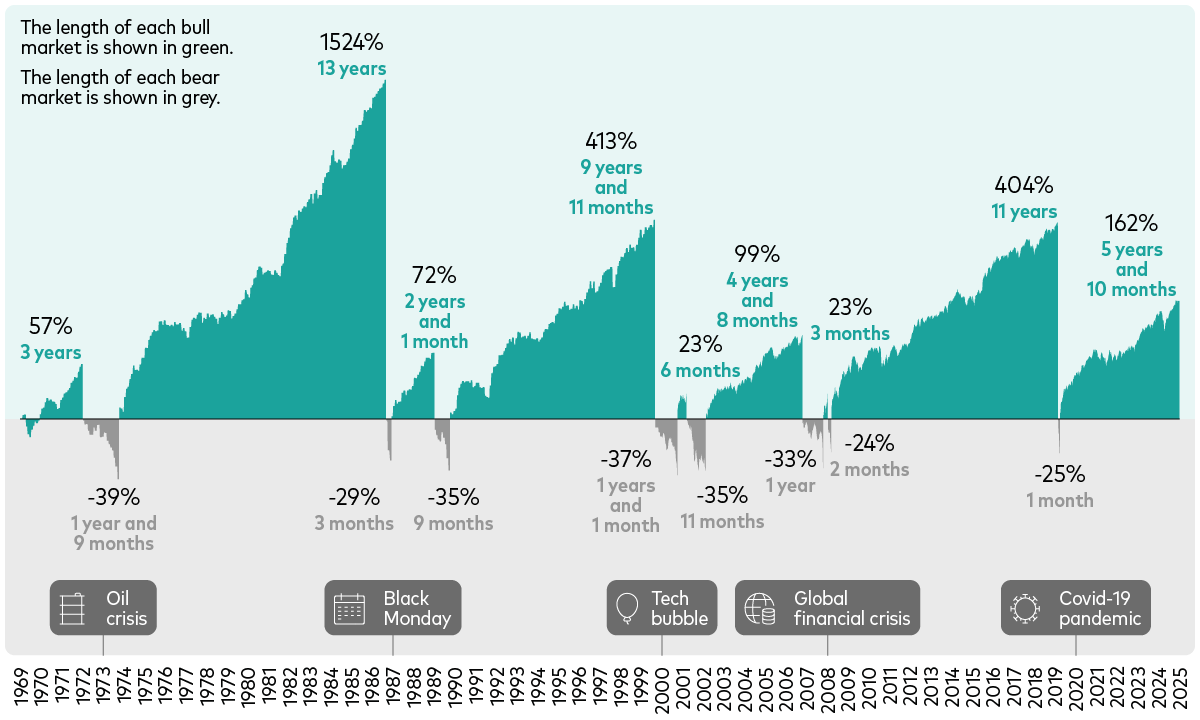
Past performance is not a reliable indicator of future results.
Notes: Calculations are based on the MSCI World total return index (GBP) from 1 January 1970 to 31 December 2025, with all net dividends reinvested.
Source: Vanguard calculations in GBP, based on data from Bloomberg, as at 31 December 2025.
The bottom line
Rather than trying to predict exactly when the next boom or bust will happen, investors are often better served by staying diversified, maintaining a long-term perspective and resisting the urge to react to short-term market movements.
By focusing on what you can control and sticking with your plan, you'll give yourself a better chance of achieving investment success over the long term.

Investment risk information
The value of investments, and the income from them, may fall or rise and investors may get back less than they invested.
Past performance is not a reliable indicator of future results.
Important information
Vanguard only gives information on products and services and does not give investment advice based on individual circumstances. If you have any questions related to your investment decision or the suitability or appropriateness for you of the product(s) described, please contact your financial adviser.
This is designed for use by, and is directed only at, persons resident in the UK.
The information contained herein is not to be regarded as an offer to buy or sell or the solicitation of any offer to buy or sell securities in any jurisdiction where such an offer or solicitation is against the law, or to anyone to whom it is unlawful to make such an offer or solicitation, or if the person making the offer or solicitation is not qualified to do so. The information does not constitute legal, tax, or investment advice. You must not, therefore, rely on it when making any investment decisions.
Issued by Vanguard Asset Management Limited, which is authorised and regulated in the UK by the Financial Conduct Authority.
© 2026 Vanguard Asset Management Limited. All rights reserved.
5805479