
Is it better to overpay my mortgage or invest?
Should you prioritise paying down your mortgage or investing? We compare mortgage overpayment savings with potential investment returns to help you assess which could work harder for you.



Deciding what to do with spare cash each month can be a powerful way to strengthen your financial position. A common dilemma is whether to use that money to overpay your mortgage or to invest it instead.
Overpaying your mortgage reduces the total interest you pay and can help you become mortgage free sooner. Investing, meanwhile, has the potential to grow your money over time and may deliver greater long-term returns, depending on market performance.
In this article, we explore the pros and cons of mortgage overpayments and compare the potential savings with the returns you might achieve from investing.
Overpaying a mortgage – key considerations
Making mortgage overpayments reduces the amount of money you owe, which can be appealing for several reasons:
- you could be mortgage-free sooner
- you’ll pay less interest overall
- you may qualify for a lower rate when you remortgage
- you’ll be less exposed if interest rates rise in future
However, it’s important to weigh these benefits against the potential drawbacks:
- most lenders charge a fee if you overpay more than 10% of your remaining mortgage balance in a year
- money put into your mortgage might be less accessible than savings or investments
- depending on your mortgage rate, the interest you save could be lower than the returns you could earn by investing
When is it better to invest, instead of overpaying?
Whether you’re better off overpaying your mortgage or investing will partly depend on your mortgage rate. It will also depend on how your investments perform.
In general, the lower the mortgage rate, the stronger the case for investing. That’s because the long-term returns from investments can outweigh the interest saved by overpaying your mortgage.
Mortgage rates today sit at around 4%, which is relatively low compared with much of the period since 2000. Over the past two decades, rates have risen and fallen through several economic cycles, reaching above 6% in the early 2000s, falling to historic lows during the late 2010s and early 2020s, and then rising again in response to inflation1.
Mortgage rates so far this century
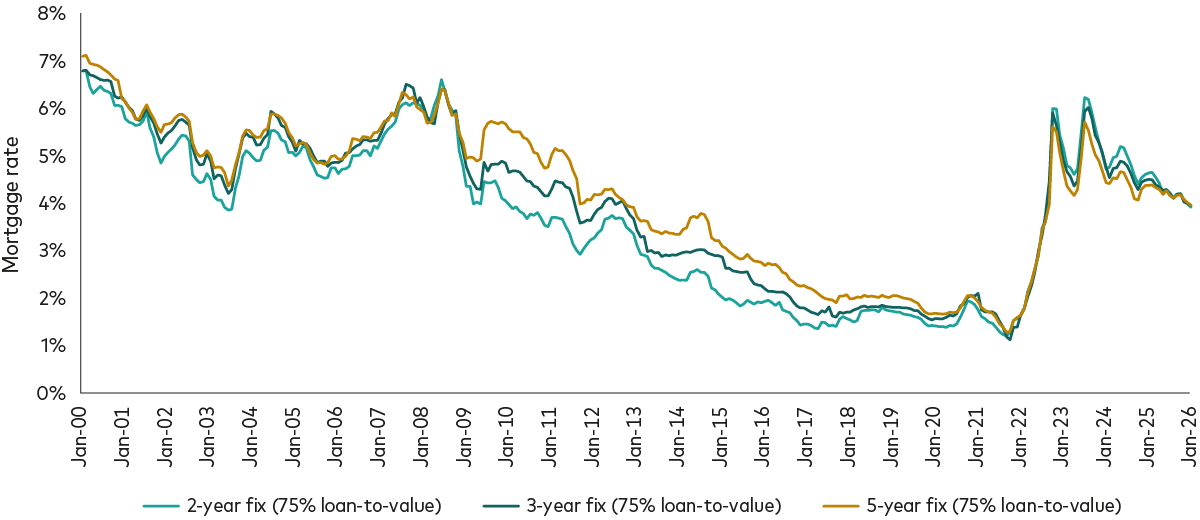
Source: Bank of England data from 31 January 2000 to 31 January 2026.
Overpaying a mortgage versus investing: a comparison
We compared the potential savings from overpaying a mortgage with the returns from investing over the next 10 years.
Savings from overpaying a mortgage
We looked at the impact of making a £15,000 mortgage overpayment at the start of a 10-year term, assuming an outstanding mortgage balance of £250,000.
The results:
- for a 5-year fixed-rate of 4.19%, the interest saved over 10 years would be £3,911
- for a 3 year fix at 4.05%, the saving would be £3,279
- for a 2 year fix at 3.99%, it would be £2,985
Potential return from investing through an ISA
We then compared this with the potential returns from investing £15,000 over 10 years using Vanguard’s forecasts. We assumed the investment was held in an individual savings account (ISA), where income and gains are tax-free.
The results:
- projected returns ranged from £10,000 to £11,000, depending on the mix of shares and bonds2
- meaning an investor could be £6,000 to £8,000 better off than if they’d overpaid their mortgage
Remember, these are forecasts, not guarantees.
Potential return from investing through a pension
Investing through a pension could lead to even higher outcomes because personal pension contributions benefit from tax relief. That means an £80 contribution is boosted to £100 if you’re a basic-rate taxpayer. Higher-rate and additional-rate taxpayers can claim an additional £20 and £25, respectively, through their self-assessment tax return.
The results for a higher-rate taxpayer:
- tax relief boosts the £15,000 contribution to £25,000 (assuming they claim the extra tax relief and add it to their pension)
- projected returns on this amount range from around £16,500 to £17,600
- meaning they could be £12,500 to £14,600 better off3 than if they’d overpaid their mortgage
Bear in mind that you can’t access money in a pension until age 55 (rising to age 57 from April 2028). And when you do take money out, up to 25% can be taken as tax-free cash (capped at £268,275) but the rest will be taxed as income. With ISAs, you can take money out whenever you like, tax free. Read more about the differences between ISAs and pensions.
Investment returns vs savings from overpaying a mortgage
Potential returns from investing £15,000 over 10 years versus interest saved by a £15,000 mortgage overpayment
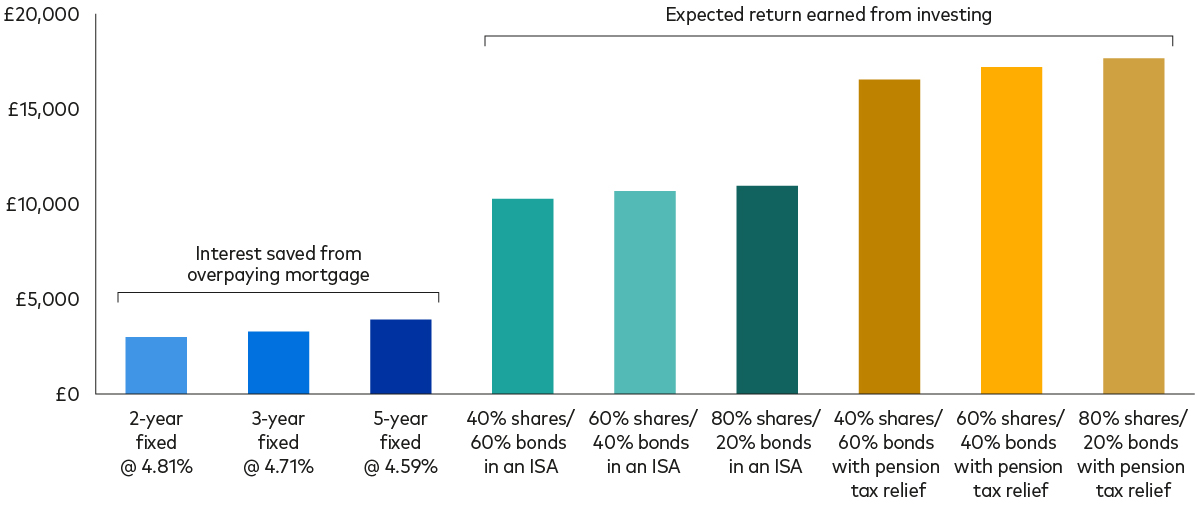
Sources: Mortgage calculations: Vanguard analysis of mortgage rates – rates after the fixed-rate period are based on market interest-rate expectations as at 31 January 2026. ISA and pension projected returns: Vanguard calculations using the Vanguard Capital Markets Model (VCMM), which forecasts annualised4 returns of 5.4% for a portfolio containing 40% shares and 60% bonds; 5.5% for 60% shares and 40% bonds; and 5.6% for 80% shares and 20% bonds (as at 31 January 2026).
IMPORTANT: The projections and other information generated by the Vanguard Capital Markets Model (VCMM) regarding the likelihood of various investment outcomes are hypothetical in nature, do not reflect actual investment results, and are not guarantees of future results. Distribution of return outcomes from the VCMM are derived from 10,000 simulations for each modeled asset class. Results from the model may vary with each use and over time.
Deciding if overpaying your mortgage or investing is right for you
If you’re able to leave your money invested for at least five years and are comfortable with market ups and downs, investing may offer greater long-term growth potential. Mortgage overpayments, on the other hand, provide a guaranteed saving equal to your interest rate and reduce your debt with certainty.
Before deciding, it’s important to ensure you have enough cash set aside for unexpected expenses. An accessible emergency fund can prevent you from relying on credit or withdrawing investments at an unfavourable time.
The right approach will depend on your circumstances, including:
- attitude to risk: how much risk you’re willing to take with your money and how much you can afford to lose (overpaying is like getting a guaranteed return on your money; investing offers higher potential returns but carries risk)
- financial goals: your short, medium and long-term priorities
- access to cash: whether you may need funds at short notice
- mortgage position: your outstanding balance, mortgage rate and any early repayment charges
If you’re unsure which approach is right for you, a financial adviser can help you weigh up the trade-offs and decide how best to make use of your spare cash.
1 Inflation is the rise in prices for goods and services over time, meaning your money buys less than it used to.
2 Bonds are a type of loan issued by governments or companies, which typically pay a fixed amount of interest and return the capital at the end of the term.
3 This assumes 20% tax relief is invested at the beginning of the first year, compounding for a total of 10 years. The remaining tax relief (a further 20%) is claimed back through the investor’s annual tax return and is invested at the beginning of the second year, compounding for a total of nine years only.
4 Annualised returns show what an investor would earn over a period of time if the annual return was compounded (i.e. the investor earns a return on their return as well as the original capital).

IMPORTANT: The projections or other information generated by the Vanguard Capital Markets Model® regarding the likelihood of various investment outcomes are hypothetical in nature, do not reflect actual investment results, and are not guarantees of future results. VCMM results will vary with each use and over time. The VCMM projections are based on a statistical analysis of historical data. Future returns may behave differently from the historical patterns captured in the VCMM. More important, the VCMM may be underestimating extreme negative scenarios unobserved in the historical period on which the model estimation is based.
The Vanguard Capital Markets Model® is a proprietary financial simulation tool developed and maintained by Vanguard’s primary investment research and advice teams. The model forecasts distributions of future returns for a wide array of broad asset classes. Those asset classes include US and international equity markets, several maturities of the U.S. Treasury and corporate fixed income markets, international fixed income markets, US money markets, commodities, and certain alternative investment strategies. The theoretical and empirical foundation for the Vanguard Capital Markets Model is that the returns of various asset classes reflect the compensation investors require for bearing different types of systematic risk (beta). At the core of the model are estimates of the dynamic statistical relationship between risk factors and asset returns, obtained from statistical analysis based on available monthly financial and economic data from as early as 1960. Using a system of estimated equations, the model then applies a Monte Carlo simulation method to project the estimated interrelationships among risk factors and asset classes as well as uncertainty and randomness over time. The model generates a large set of simulated outcomes for each asset class over several time horizons. Forecasts are obtained by computing measures of central tendency in these simulations. Results produced by the tool will vary with each use and over time.
The primary value of the VCMM is in its application to analysing potential client portfolios. VCMM asset-class forecasts—comprising distributions of expected returns, volatilities, and correlations—are key to the evaluation of potential downside risks, various risk–return trade-offs, and the diversification benefits of various asset classes. Although central tendencies are generated in any return distribution, Vanguard stresses that focusing on the full range of potential outcomes for the assets considered, such as the data presented in this paper, is the most effective way to use VCMM output.
The VCMM seeks to represent the uncertainty in the forecast by generating a wide range of potential outcomes. It is important to recognise that the VCMM does not impose “normality” on the return distributions, but rather is influenced by the so-called fat tails and skewness in the empirical distribution of modeled asset-class returns. Within the range of outcomes, individual experiences can be quite different, underscoring the varied nature of potential future paths. Indeed, this is a key reason why we approach asset-return outlooks in a distributional framework.
Investment risk information
The value of investments, and the income from them, may fall or rise and investors may get back less than they invested.
Any projections should be regarded as hypothetical in nature and do not reflect or guarantee future results.
The eligibility to invest in either ISA ot Junior ISA depends on individual circumstances and all tax rules may change in future.
Eligibility to invest in a Vanguard Personal Pension depends on your individual circumstances. Please be aware that pension and tax rules may change in the future and the value of investments can go down as well as up, so you might get back less than you invested. You cannot usually access your pension savings or make any withdrawals until the age of 55, rising to the age of 57 in 2028.
If you are not sure of the suitability or appropriateness of any investment, product or service you should consult an authorised financial adviser. Please note this may incur a charge.
Any tax reliefs referred to are those available under current legislation, which may change, and their availability and value will depend on your individual circumstances. If you have questions relating to your specific tax situation, please contact your tax adviser.
Important information
Vanguard only gives information on products and services and does not give investment advice based on individual circumstances. If you have any questions related to your investment decision or the suitability or appropriateness for you of the product[s] described, please contact your financial adviser.
This is designed for use by, and is directed only at, persons resident in the UK.
The information contained herein is not to be regarded as an offer to buy or sell or the solicitation of any offer to buy or sell securities in any jurisdiction where such an offer or solicitation is against the law, or to anyone to whom it is unlawful to make such an offer or solicitation, or if the person making the offer or solicitation is not qualified to do so. The information does not constitute legal, tax, or investment advice. You must not, therefore, rely on it when making any investment decisions.
Issued by Vanguard Asset Management Limited, which is authorised and regulated in the UK by the Financial Conduct Authority.
© 2026 Vanguard Asset Management Limited. All rights reserved.
5282442