
Market volatility is part of investing. Here’s how to handle it
Learn what market volatility is, why markets rise and fall, and how to stay focused on your long-term investing goals.

Seeing markets fall can feel unsettling, especially when you’ve only just started investing. After all, no one likes seeing the value of their investments fall.
Over time, you’ll become more familiar with the ups and downs, which can help build your confidence. That won’t automatically make them easy to go through, but they may feel less unexpected.
Markets, like us, have good times and bad times. Understanding that periods of volatility are a normal part of the investment journey can help you feel more prepared.
Why do markets go up and down?
Company updates, changes in the economy and world events can all affect markets, making share prices move up and down. Investors can sometimes overreact to bad news, pushing prices lower. This can be unsettling, but it may also create opportunities.
Markets don’t go up in a straight line, and investors rarely get the average market return in a single year. What matters more for long-term investors is how those returns add up over time.
It’s part of the journey
A bad year can feel longer than a good year because losses hurt us more than gains reward us. So it may be reassuring to know that the good times – known as ‘bull markets’, when markets are rising – tend to be stronger and last longer than the bad times – known as ‘bear markets’, when markets are falling.
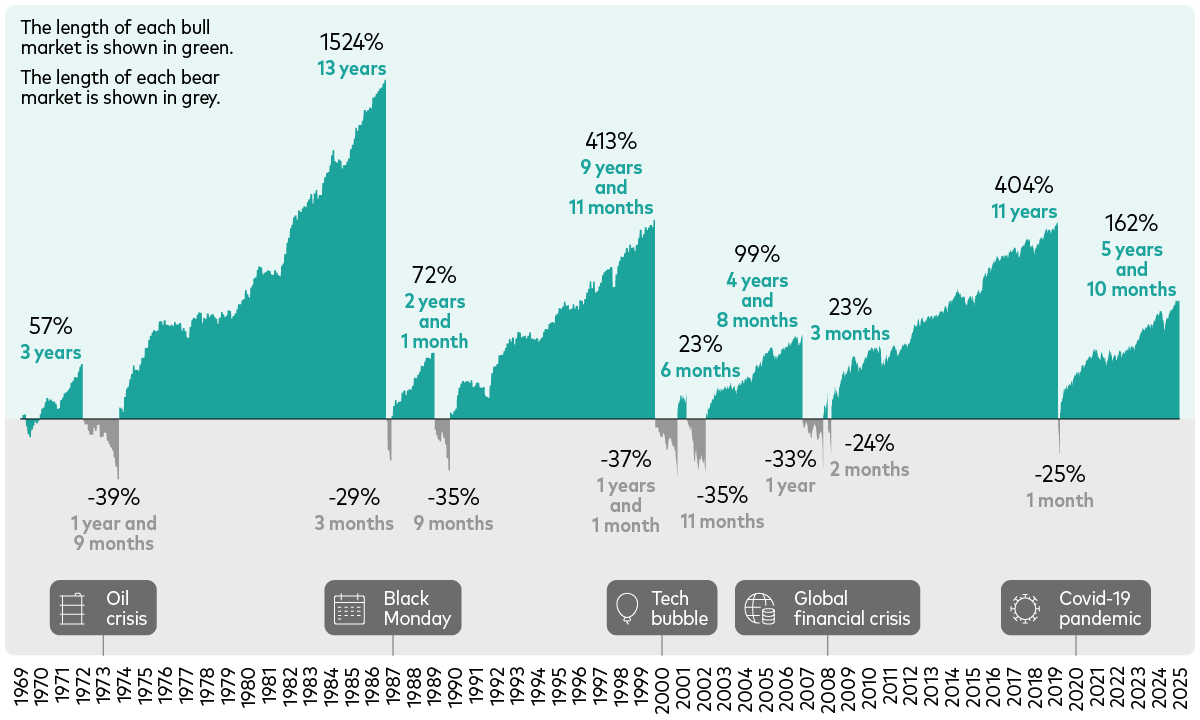
Past performance is not a reliable indicator of future results.
Notes: Calculations are based on the MSCI World total return index (GBP) from 1 January 1970 to 31 December 2025, with all net dividends reinvested.
Source: Vanguard calculations in GBP, based on data from Bloomberg, as at 31 December 2025.
Four tips to help get you through times of market volatility
1) Remember that markets have been here before, even if you haven’t
When markets fall it can knock your confidence, especially if you haven’t experienced volatility before.
That’s why looking back in history can be useful. It reminds us that downturns are normal and that staying invested gives your money the chance to recover and grow over time.
The chart below shows what markets have endured over the past 30 years, from financial crises to wars. Despite these events, markets have remained resilient and continued to rise.
Markets have often bounced back soon after geopolitical shocks

Past performance is not a reliable indicator of future results. The performance of an index is not an exact representation of any particular investment, as you cannot invest directly in an index.
Notes: Index returns are from 1 January 1995 to 31 December 2025 and include the reinvestment of all net dividends. Returns do not include the impact of fees. Both indices were rebased so that 1 January 1995 equals 100.
Source: Vanguard, Bloomberg as at 10 February 2026.
Staying invested isn’t always easy, and there may be times when the outlook feels particularly uncertain. But building wealth isn’t about avoiding those painful periods – it’s about having the courage to ride them out.
2) Invest in a balanced portfolio that’s right for you
In times of volatility, it’s always a good idea to check how you’re currently invested. Do you have some money tucked away in safer areas, like bonds1? Are you taking on too much risk?
The exact mix of assets will depend on your attitude to risk and how long you’re investing for. If you’re investing for decades, you have more time to ride out the market’s ups and downs. Taking more risk by holding more shares than bonds gives your investments greater potential for long-term growth.
As well as investing in different assets, it’s also important to spread your money across different countries and industries. They may not all respond to events in the same way, so when one part of the market isn’t doing well, it has less impact on your overall portfolio.
3) Try not to panic when markets fall
Investing brings out our human instinct to protect what we’ve got – and our hope of growing it. When markets fall, we worry about losing more. When they rise, we worry about missing out. Both feelings are natural.
That’s why, when markets fall, it can be tempting to sell your investments to ease the panic and avoid losing more.
But selling after markets have gone down means locking in those losses. And you’ll most likely wait until you feel confident before investing again, by which point markets will probably have raced ahead. As our research on market timing shows, staying invested can matter more than getting your timing right. Staying invested gives your investments the chance to recover and potentially grow further.
Having a routine can make it easier to stick with your investment plan. Investing a regular sum each month means that you’ll be ‘buying the dip’ – getting more for your money when markets fall – without trying to predict the best time to invest.
4) Stay focused on your long-term goals
You’re likely investing with a specific goal in mind, whether that’s buying your first home, saving for retirement or another meaningful milestone.
When markets fall, it can help to go back to your ‘why’. Keeping your goal at the front of your mind during these periods can give you the strength and motivation to stay invested.
It can also put short-term ups and downs into perspective. If you’re investing for years or decades, a difficult few days, weeks or months may be only a small part of your overall investment journey.
It’s natural to want to check how your investments are doing, especially when markets are particularly volatile. When you do, try to look beyond the latest market moves and remember what you’re investing for.
1 Bonds are a type of loan issued by governments or companies, which typically pay a fixed amount of interest and return the capital at the end of the term.

Investment risk information
Investing gives your money the opportunity to grow over time, but market movements mean values can rise and fall along the way.
Past performance is not a reliable indicator of future results.
Important information
This is a marketing communication.
Vanguard only gives information on products and services and does not give investment advice based on individual circumstances. If you have any questions related to your investment decision or the suitability or appropriateness for you of the product(s) described, please contact your financial adviser.
This is designed for use by, and is directed only at, persons resident in the UK.
The information contained herein is not to be regarded as an offer to buy or sell or the solicitation of any offer to buy or sell securities in any jurisdiction where such an offer or solicitation is against the law, or to anyone to whom it is unlawful to make such an offer or solicitation, or if the person making the offer or solicitation is not qualified to do so. The information does not constitute legal, tax, or investment advice. You must not, therefore, rely on it when making any investment decisions.
Issued by Vanguard Asset Management Limited, which is authorised and regulated in the UK by the Financial Conduct Authority.
© 2026 Vanguard Asset Management Limited. All rights reserved.
6113153