
How to save for retirement in your 20s and 30s
Discover how to save for retirement in your 20s and 30s. Learn about the power of compounding, maximising workplace pensions and budgeting tips to secure your financial future.

Your 20s and 30s can be packed with challenges, from student loans and rent to buying a home, starting a family or planning your next adventure. With so much going on, saving for retirement can feel like something to worry about “later”.
But even small steps now can make a massive difference for your future self. The earlier you start, the easier it is, and you’ll thank yourself down the line.
Start early – let your money work for you
Think of saving for retirement like rolling a snowball down a hill. At first, it’s tiny, but as it rolls, it grows – fast. This is because of the power of compounding – when you earn returns on the money you invest, as well as on the returns themselves. Even small monthly contributions can snowball into a significant sum over time.
Imagine you start saving £100 a month at age 25 and earn an average annual return of 5% after fees. You could have nearly £150,000 by the time you’re 65, according to our calculations.
But if you wait until you’re 35 to start, you’d have just over £80,000. That’s a £70,000 difference all because you waited 10 more years to get started – reflecting both the extra contributions and additional time for growth.
Saving for retirement from age 25 vs 35
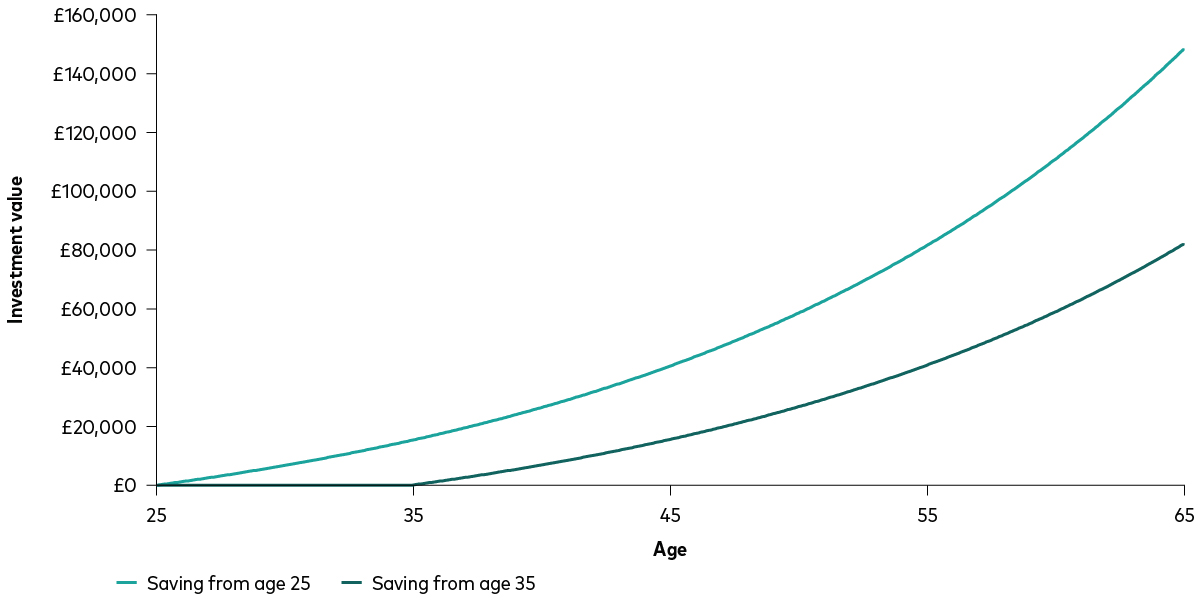
Notes: This hypothetical scenario is for illustrative purposes only and doesn’t represent a particular investment or its expected returns. It assumes annual returns of 5% after fees. Balances reflect the value at the end of each period.
Source: Vanguard calculations.
Make the most of your workplace pension
One of the best ways to kickstart your retirement savings is by maximising your workplace pension. Some employers will match or even exceed your contributions up to a certain percentage of your salary.
For example, with auto-enrolment, many employers pay in 3% of your salary and you pay in 5%1, but if you bump your contribution to, say, 7% they might also pay in 7%. On a salary of £50,000, you’d have an extra £3,000 a year going into your pension.
You can find out what your employer offers by asking your HR department.
Self-employed or want more control? Try a SIPP
If you’re freelancing, side hustling or your employer’s pension isn’t enough, a self-invested personal pension (SIPP) gives you flexibility and control. You can:
- select a ready-made retirement portfolio
- opt for our Managed Personal Pension, where we’ll select funds for you
A SIPP can also be useful for making one-off contributions, such as from a bonus, tax refund or gift.
Get a boost from tax relief
One of the biggest benefits of pension saving is tax relief. The government effectively boosts your contributions, helping your money go further.
For every £80 you pay in, you get £20 added. If you’re a higher-rate or additional-rate taxpayer, you can claim an extra £20 or £25, respectively, through your tax return or HMRC’s online service.
If you run your own business as a limited company director, you can make pension contributions from your business account. They’ll be treated as an ‘allowable business expense’, which could reduce your corporation tax bill2. Pension contributions aren't subject to employer National Insurance, so by contributing directly into your pension (rather than taking the money as salary) you could save a chunk of money that would otherwise go to the taxman.
Bring old pensions together
A SIPP is also handy if you want to combine old pensions from previous jobs.
Keeping everything in one place cuts down on admin and makes it easier to track your progress.
Budgeting and saving tips for busy lives
Saving for retirement doesn’t have to be overwhelming. Here are a few tips to make things easier:
Automate it
Set up a Direct Debit so your SIPP gets funded every month without you having to think about it. You might not even notice the money leaving your account, but it’ll be working hard for your future.
Start small
Even a small amount each month can make a big difference over time. As your income grows, you can gradually increase your contributions.
Cut back on extras
Take a look at your monthly expenses and see where you can cut back. Maybe you can cook at home more often, ditch unused subscriptions or switch to a cheaper broadband deal. Every pound saved can boost your pension.
Put windfalls to work
Received a bonus, tax refund or cash gift? Consider putting some of it towards your retirement savings.
The bottom line
Retirement might feel a long way off, but time is one of the most powerful tools an investor has. Even small contributions made today could make a big difference in the future. The key is simply getting started.
Check out our hub for more tips on growing your pension.
1 The auto-enrolment minimum contribution for the tax year 2026-27 is 8% of your salary between £6,420 and £50,270. The 8% comprises 5% from you (including tax relief) and 3% from your employer.
2 For a company pension contribution to be an allowable business expense, it must pass the ‘wholly and exclusively’ test. This means that HM Revenue & Customs (HMRC) must deem the contribution to be wholly and exclusively for the employer’s trade or profession. HMRC may want to establish whether your total remuneration, including pension contributions, is reasonable for the work being done.

Investment risk information
Investing gives your money the opportunity to grow over time, but market movements mean values can rise and fall along the way.
Any projections should be regarded as hypothetical in nature and do not reflect or guarantee future results.
Eligibility to invest in a Vanguard Personal Pension depends on your individual circumstances. Please be aware that pension and tax rules may change in the future and the value of investments can go down as well as up, so you might get back less than you invested. You cannot usually access your pension savings or make any withdrawals until the age of 55, rising to the age of 57 in 2028.
If you are not sure of the suitability or appropriateness of any investment, product or service you should consult an authorised financial adviser. Please note this may incur a charge.
Any tax reliefs referred to are those available under current legislation, which may change, and their availability and value will depend on your individual circumstances. If you have questions relating to your specific tax situation, please contact your tax adviser.
Important information
This is a marketing communication.
Vanguard only gives information on products and services and does not give investment advice based on individual circumstances. If you have any questions related to your investment decision or the suitability or appropriateness for you of the products described, please contact your financial adviser.
This is designed for use by, and is directed only at, persons resident in the UK.
The information contained herein is not to be regarded as an offer to buy or sell or the solicitation of any offer to buy or sell securities in any jurisdiction where such an offer or solicitation is against the law, or to anyone to whom it is unlawful to make such an offer or solicitation, or if the person making the offer or solicitation is not qualified to do so. The information does not constitute legal, tax, or investment advice. You must not, therefore, rely on it when making any investment decisions.
Vanguard will manage your investments in the Managed SIPP on your behalf. You will not be able to place trades on your own account.
Issued by Vanguard Asset Management Limited, which is authorised and regulated in the UK by the Financial Conduct Authority.
© 2026 Vanguard Asset Management Limited. All rights reserved.
5978442