
What do the new ISA rules mean for investors?
The government has announced new ISA rules from 6 April 2027, including changes to the cash ISA limit and the treatment of cash held in stocks and shares ISAs. Find out what's changing and what the reforms could mean for your long-term savings and investments.

The government has announced further changes to individual savings account (ISA) rules, which will come into effect from 6 April 2027.
The reforms include a reduction in the annual cash ISA limit for people under 65, alongside new rules affecting cash and cash-like investments held within a stocks and shares ISA.
What are the new ISA rules?
The following changes will apply from 6 April 2027:
Changes for investors under age 651:
- The amount that can be paid into cash ISAs each tax year will reduce from £20,000 to £12,000.
- Transfers from a stocks and shares ISA to a cash ISA will no longer be allowed.
Changes affecting all investors:
- Interest paid on cash held in a stocks and shares ISA will be subject to a 22% charge. To put that into context, if you held £10 in cash in your stocks and shares ISA and earned 1.85% interest a year2 (around 19 pence), the charge on that interest would be around 4 pence.
- Money market funds can continue to be held within a stocks and shares ISA, provided they do not make up 100% of the investments.
Some aspects of the new rules are still subject to further guidance from the government.
What hasn't changed?
Amid all the headlines, it's worth remembering what hasn't changed.
The overall ISA allowance remains £20,000.
And the core benefits of a stocks and shares ISA remain the same. Any growth, dividends3 and interest generated by investments in a stocks and shares ISA remain tax free, helping you keep more of your returns. The new rules only affect interest earned on cash.
Cash and investing both have a role
The changes shouldn't be viewed as a choice between cash and investing. Both can play an important role in a financial plan.
Cash can be useful for emergency savings, short-term goals and holding funds temporarily while deciding how to invest. However, holding too much cash can come with a cost.
Inflation can gradually reduce the spending power of money over time, which means cash may not grow enough to support your future goals.
That's where investing can help.
History shows that shares have delivered much higher returns than cash over long periods.
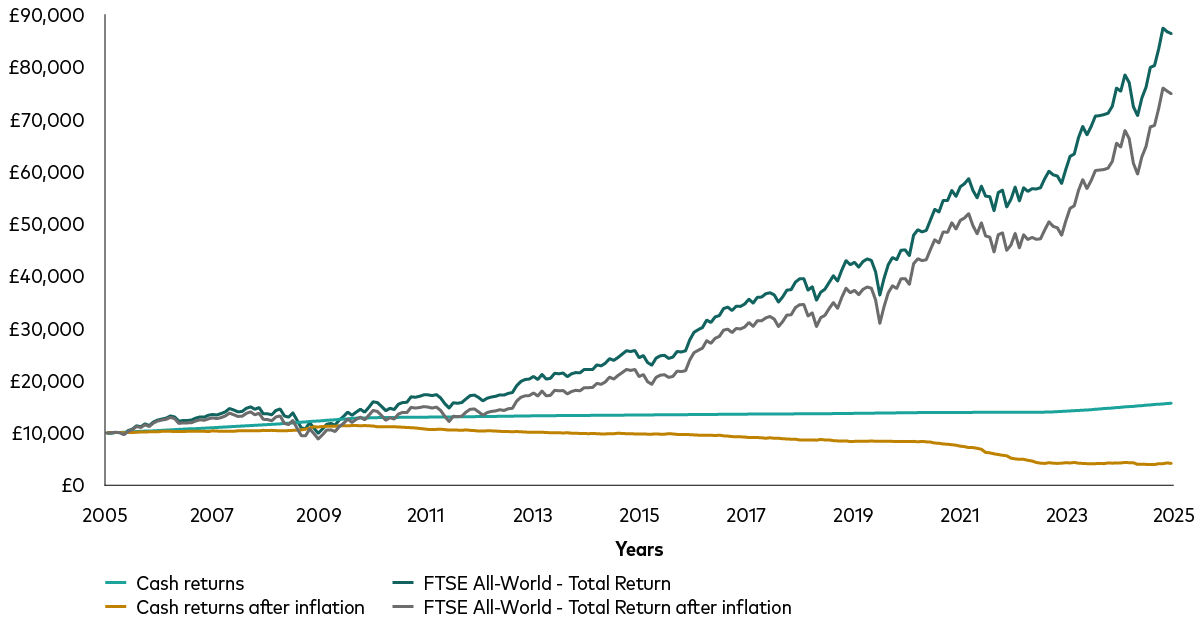
The chart below compares the value of £10,000 saved in cash and invested globally since the end of December 2004, both before and after inflation.
- If you held the money in cash it would grow to around £15,600. But inflation means its real value reduces to around £4,100.
- If you invested it globally in shares, it would grow to around £86,400 and be worth around £74,000 after inflation.
Returns from £10,000 in cash and shares, before and after the effects of inflation
Past performance is not a reliable indicator of future results. The performance of an index is not an exact representation of any particular investment, as you cannot invest directly in an index.
Notes: Cash returns represented by the UK Sterling Overnight Index Average benchmark (SONIA), which reflects the average rate of interest banks pay to borrow overnight, unsecured sterling cash on a given day. Global shares represented by the FTSE All-World Index with dividends reinvested. Inflation represented by the UK Retail Price Index (RPI).
Source: Factset, Vanguard calculations based on period 31 December 2004 to 31 December 2025.
What if you want to keep some money in cash?
The new rules recognise that investors may still need to hold some cash or cash-like investments within a stocks and shares ISA.
For example, you might temporarily hold cash after making a contribution while you decide where to invest.
However, instead of holding cash, another option is to invest in a money market fund. A money market fund is a low-risk investment that aims to give you a slightly higher return than cash.
Money market funds will continue to be permitted within stocks and shares ISAs from April, provided they don’t make up the whole portfolio.
What about Lifetime ISAs?
Alongside these reforms, the government has launched a consultation on a new ISA product designed to help first-time buyers save for a home. This new product would eventually replace the Lifetime ISA.
Vanguard doesn’t offer a Lifetime ISA. We take a thoughtful approach to introducing new products, focusing on the needs of our existing and prospective clients.
The bottom line
The new rules don't change the key role of investing in helping people meet their long-term financial goals.
Cash remains important for emergencies and shorter-term needs. But for money that won't be needed for many years, a stocks and shares ISA continues to offer a tax-efficient way to invest for the future.
1 Investors will be treated as aged 65 from the start of the tax year in which they turn 65.
2 The 1.85% interest rate used in the example reflects Vanguard’s cash rate as at 24 June 2026.
3 Dividends are the payments some companies make to their shareholders out of their profits.

Investment risk information
The value of investments, and the income from them, may fall or rise and investors may get back less than they invested.
Past performance is not a reliable indicator of future results.
The eligibility to invest in either ISA or Junior ISA depends on individual circumstances and all tax rules may change in future.
Any tax reliefs referred to are those available under current legislation, which may change, and their availability and value will depend on your individual circumstances. If you have questions relating to your specific tax situation, please contact your tax adviser.
An investment in a money market fund is not a guaranteed investment. An investment in a money market fund is different from an investment in deposits, as the amount invested in a money market fund is capable of fluctuation. Money market funds do not rely on external support for guaranteeing the liquidity of the money market fund or stabilising the Net Asset Value per share. The risk of loss of the amount invested shall be borne by the investor.
For further information on risks please see the “Risk Factors” section of the prospectus on our website.
Important information
This is a marketing communication.
Vanguard only gives information on products and services and does not give investment advice based on individual circumstances. If you have any questions related to your investment decision or the suitability or appropriateness for you of the product(s) described, please contact your financial adviser.
This is designed for use by, and is directed only at, persons resident in the UK.
The information contained herein is not to be regarded as an offer to buy or sell or the solicitation of any offer to buy or sell securities in any jurisdiction where such an offer or solicitation is against the law, or to anyone to whom it is unlawful to make such an offer or solicitation, or if the person making the offer or solicitation is not qualified to do so. The information is general in nature and does not constitute legal, tax, or investment advice. Potential investors are urged to consult their professional advisers on the implications of making an investment in, holding or disposing of "units/shares", and the receipt of distribution from any investment.
The Authorised Corporate Director for Vanguard® Investments Money Market Funds is Vanguard Investments UK, Limited. Vanguard Asset Management, Limited is a distributor of Vanguard® Investments Money Market Funds.
Issued by Vanguard Asset Management Limited, which is authorised and regulated in the UK by the Financial Conduct Authority.
© 2026 Vanguard Asset Management Limited. All rights reserved.
5701173